The Brutal Math of Dairy Farming: Why Most A2 Farms Fail (And How to Make Lakhs Monthly)
Let’s skip the romantic daydream of a peaceful countryside life where you gently pet your cows and watch profits roll in. If you treat a Desi cow dairy farm like a hobby, it will eat up your life savings faster than a hungry heifer clears a fresh patch of green alfalfa.
When I first sat down with a calculator to map out the macro-economics of an organic dairy farm in India, I fell into the same excel-sheet trap that ruins hundreds of corporate professionals-turned-farmers every year. You know the formula:
$$\text{10 Cows} \times \text{10 Liters} \times \text{₹75/Liter} \times \text{365 Days} = \text{Pure Profit Fantasy}$$
It looks amazing on paper. But the moment real-world friction hits—when your best milker goes into a silent heat, feed prices spike 15% due to a bad monsoon, or a farmhand walks out without notice—that paper profit completely evaporates.
If you want to survive and scale a commercial dairy venture, you have to look at the numbers like a hard-nosed economist. Let’s dissect the cold, hard operational metrics of running a 10-cow Desi dairy farm using real-world economics.
The Hidden Trap: "Dry Days" and Capacity Utilization
In my early research days, I didn't truly understand the economic impact of the inter-calving period. A cow does not function like a factory tap that you can turn on 365 days a year.
An indigenous cow operates on a biological cycle of roughly 390 days. Out of these, she will give you milk for about 275 days (lactation period) and go completely dry for about 115 days (dry period) while she prepares to give birth to her next calf.
Here is where the math gets brutal:
If all 10 of your cows go dry at the exact same time, your revenue plummets to zero, but your feed bills, labor wages, and electricity costs stay exactly the same. Your farm will go bankrupt in three months.
The Fix: Staggered Batches
To beat this, you must never buy all 10 animals at once. You buy Batch A (5 cows) in advanced pregnancy on Day 1, and Batch B (5 cows) six months later. This simple structural adjustment ensures you always have a steady stream of milking animals maintaining your baseline daily cash flow while the other half rests and rebuilds their bodies.
Feed Economics: The 70% Cost Baseline
Let's look at the actual variable cost of feeding a single lactating Sahiwal or Gir cow producing 10 liters of milk a day.
Green Fodder (Homegrown): 30 kg $\times$ ₹1.50/kg (cost of seeds, fertilizer, and irrigation) = ₹45
Dry Wheat Straw (Bhusa): 5 kg $\times$ ₹7/kg = ₹35
Farm-Mixed Concentrate Grain Formula: 6.5 kg $\times$ ₹28/kg = ₹182
Minerals & Salt: Lump sum = ₹15
Total Daily Cost to Feed One Milking Cow: ₹277
Now, let's look at a dry cow. She isn't producing milk, so her concentrate intake drops significantly, but she still requires body maintenance feed:
Total Daily Cost to Feed One Dry Cow: ₹130
The Annualized Reality Check
Over a full 390-day cycle, one cow will cost you:
$$\text{(275 Milking Days} \times \text{₹277)} + \text{(115 Dry Days} \times \text{₹130)} = \text{₹91,125 in pure feed costs alone.}$$
Multiply that by a 10-cow herd, and your baseline annual feed bill sits right at ₹9,11,250. If your strategy involves buying packaged commercial cattle feed from middleman suppliers instead of mixing your own grains and growing your own fodder, add another 30% to that expense line, effectively killing your margins.
Revenue Architecture: Direct Retail vs. Whole Societies
If you sell your premium A2 milk to local mass-collection dairy cooperative societies, they will grade your milk strictly on fat/SNF composition and pay you an average of ₹40 to ₹45 per liter.
Let's look at that specific economic model:
$$\text{27,500 Liters Total Annual Yield} \times \text{₹45/Liter} = \text{₹12,37,500 Gross Revenue}$$
Subtract your feed costs (~₹9.1 Lakhs), your full-time farm hand's labor wages (~₹1.08 Lakhs), electricity, asset depreciation, and veterinary bills. You are left with a razor-thin net annual profit of less than ₹1.5 Lakhs for an immense amount of daily physical labor. That is a failing business model.
The Solution: Premium Value-Addition
To build a highly lucrative enterprise, you have to completely bypass the traditional middleman commodity supply chain and market directly to health-conscious urban micro-markets:
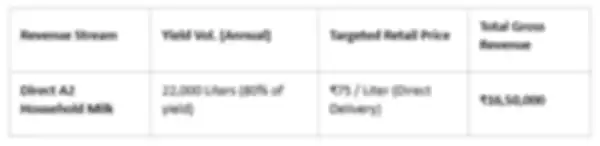
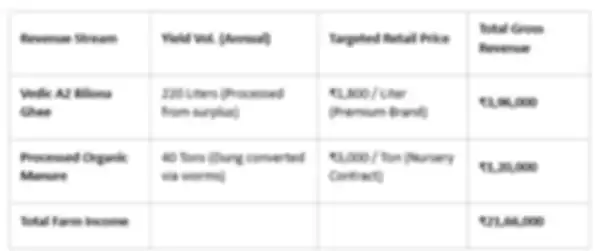
By owning your brand, controlling your logistics, and utilizing your farm's waste by-products (dung and urine converted into organic premium manure), you pull ₹21,66,000 in gross annual revenue from the exact same 10 cows.
Net Profit and ROI Breakdown
Let’s look at the final, consolidated annual income statement for a well-managed 10-cow farm layout:
Gross Annual Income: ₹21,66,000
Less: Operational Costs (Feed, Wages, Vet, Utilities): ₹6,71,800
Net Operating Profit (EBITDA): ₹14,94,200
Even after paying off a standard bank loan EMI of roughly ₹2,20,000 per year, a tightly run 10-cow farm returns a clean, cash-positive surplus of over ₹12 Lakhs annually directly to the promoter.
The Bottom Line
Dairy economics isn’t about chasing the highest volume of milk by buying fragile, high-maintenance exotic crossbreeds. It’s about building a hyper-efficient, closed-loop ecosystem. When you grow your own fodder to slash input costs, process your seasonal surplus milk into high-value Bilona ghee, and retail directly to consumers under your own brand, the math works out beautifully. Treat your farm like an agile business startup, and the numbers will take care of you.

THAKUR G
Thakur G offers quality essentials for your kitchen and spiritual needs, from pure ghee and natural sweeteners to pooja thalis and deity idols.
Follow us on


Contact Us
Call: +91 - 8689805934
WhatsApp: +91 - 8689805934
Customer Support Time: 24/7
Email: Shivam.mishra56@yahoo.com
Address: Office No. A 825, 8th Floor, Lodha Premier Signet A, DOMBIVLI east. mangaon thane - 421204, Maharashtra, Thane, 421204