How to Start a Lucrative Desi Cow Dairy Farm in India: The Ultimate Step-by-Step Guide
Let’s be honest. How many times have you stood in the supermarket aisle, looking at a milk packet, wondering, "Is this even pure?"
You are not alone. Millions of Indian households are actively moving away from mass-produced packet milk and searching for pure, unadulterated A2 milk. This massive shift in consumer mindset has made starting a Desi cow dairy farm one of the most profitable, sustainable, and satisfying agribusiness opportunities in India today.
But here is the reality check: dairy farming is not just about buying a couple of cows and milking them. It is a commitment. It requires strategy, love for the animals, and a solid business plan.
If you are planning to take the plunge, grab a cup of chai, because this comprehensive guide will walk you through exactly how to set up a successful organic dairy farm in India from scratch.
Why Desi Cows? The A2 Milk Revolution
For decades, Indian dairy setups rushed toward exotic crossbreeds like Holstein-Friesians (HF) and Jersey cows because they produce a massive volume of milk. However, the tides are turning.
Indian indigenous cattle breeds produce milk containing the A2 beta-casein protein, which is far easier on the human digestive system compared to the A1 protein found in foreign breeds. Beyond the health benefits, indigenous cow breeds are inherently built for the Indian climate. They possess a high resistance to local diseases and can withstand extreme heat without their milk production dropping drastically.
Step 1: Choosing the Right Indigenous Cow Breeds
Your profit margins will heavily depend on the genetics of your herd. You want breeds that have a proven track record of decent milk yields and strong immunity.
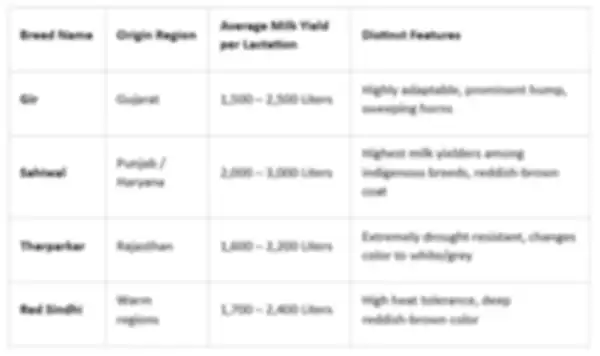
Pro Tip: Never buy your entire herd from a cattle fair (Mela). Work with certified government breeding farms or trusted, reference-checked farmers where you can check the mother’s milking records.
Step 2: Land Selection and Shed Design
Location matters. Your dairy farm business plan needs a site that has 24/7 access to clean water, uninterrupted electricity, and a clear road to transport milk to your target market quickly.
When building your dairy farm shed design, avoid the traditional practice of keeping cows tied up all day. Use a loose housing system.
1.Orient the shed properly:Sun protection.
Build the shed in an East-West direction. This simple layout ensures your cows get maximum shade and stay cool during scorching Indian summers.
2.Create separate resting and moving zones:Loose housing.
Provide a covered area (at least 40 sq. ft. per cow) with soft bedding, and an open paddock area (80 sq. ft. per cow) where they can walk freely. Happy cows produce better milk!
3.Install non-slippery, inclined flooring:Hygiene and safety.
The concrete floor must have a mild slope (1 in 40) leading to a drainage channel. Ensure the surface is grooved so the cows don't slip and injure their udders.
Step 3: Master the Feeding and Green Fodder Strategy
If you buy your cattle feed entirely from the market, your dairy farm will struggle to stay profitable. Feed accounts for 60-70% of total operational costs. To keep these costs down, you need a smart, sustainable feeding plan.
An ideal daily diet chart for an adult milking Desi cow includes:
Green Fodder (25-30 kg): Co-4/Co-5 Napier grass, Super Napier, Lucerne, or Sorghum. Dedicate 1 acre of land for every 4-5 cows to cultivate your own fodder.
Dry Fodder (4-5 kg): Paddy straw or wheat straw to provide essential roughage.
Concentrate Feed (1-2 kg + 0.5 kg extra per liter of milk produced): A balanced mix of mustard cake, cotton seed cake, wheat bran, and crushed maize.
Mineral Mixture (50-100 grams): Crucial for reproductive health and consistent milk production.
Step 4: Secure Financial Backing and Government Subsidies
Setting up a commercial farm requires capital. Fortunately, the Indian government actively rewards entrepreneurs who choose to preserve indigenous cattle breeds.
You can leverage the NABARD dairy farming subsidy or explore the Rashtriya Gokul Mission. Under various state and central schemes, entrepreneurs can get a 25% to 33.33% subsidy on capital investments for setting up dairy units, purchasing animals, or buying milk chilling equipment. Approach your local district veterinary officer to get the latest, state-specific guidelines before applying to your commercial bank.
Step 5: Diversifying Beyond Milk for Maximum Profit
Let's do some straight talking: if you only sell raw milk, a sudden dip in market prices or a minor issue on the farm can hit your pocket hard. True profitability in a Desi cow dairy farm lies in value addition.
Instead of selling milk at ₹60/liter, convert it into Vedic A2 Bilona Ghee. Pure Gir or Sahiwal cow ghee made via the traditional curd-churning method easily sells between ₹1,500 to ₹2,500 per liter online.
Furthermore, adopt zero-budget natural farming (ZBNF) principles. Do not waste cow dung and urine. Convert them into organic liquid nutrients like Jeevamrutha, or compress the dung into organic vermicompost logs. You can sell these to local farmers or urban nurseries as high-grade premium fertilizer.
Final Thoughts: Start Small, Scale Smart
The biggest mistake budding dairy entrepreneurs make is buying 50 cows on day one. Dairy farming is a live management business.
Start with 5 to 10 high-quality cows. Understand their heat cycles, master the milking routine, build your local distribution network, and figure out the logistics. Once your cash flow stabilizes and you are comfortable managing the herd, use the profits to scale up.
It takes patience, sweat, and discipline—but there is nothing quite like building a sustainable business that nourishes your community while generating robust returns.
Are you ready to build your own dairy empire? Let's take the next logical step together.
Here is a detailed, professional Project Report for a 10-Cow Desi Cow Dairy Farm. This report is structured specifically to meet the evaluation criteria of commercial banks and NABARD appraisal officers for agricultural term loans.
1. Executive Summary & Project Highlights
This project outlines the financial and technical viability of establishing a boutique commercial dairy farm with 10 high-yielding indigenous (Desi) cows (specifically Gir or Sahiwal breeds). The farm will focus on premium A2 Milk distribution and high-value A2 Bilona Ghee production, leveraging the growing urban demand for organic dairy products.

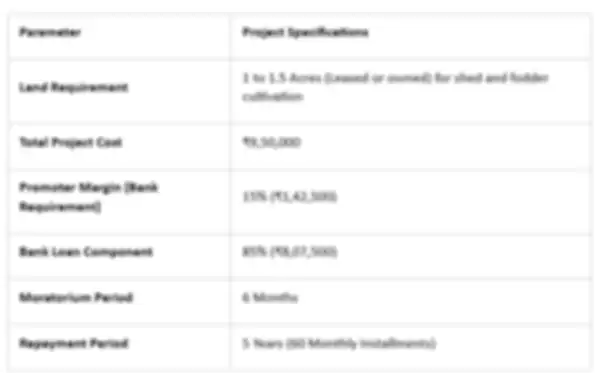
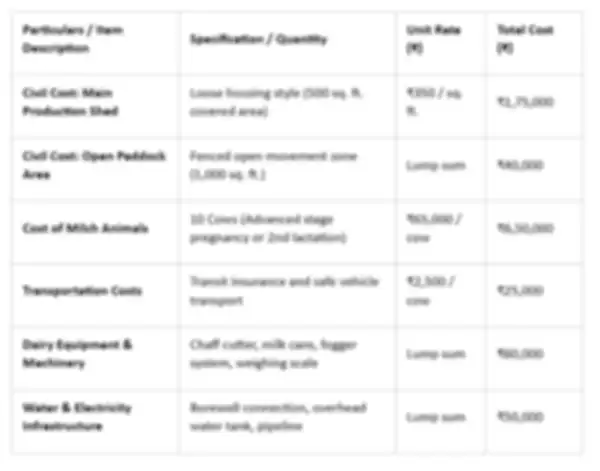
2. Capital Expenditure (CapEx) Breakdown
This table details the initial fixed assets required to kickstart operations. Costs are estimated based on prevailing market rates in India for standard dairy infrastructure.

3. Annual Operational Expenditure (OpEx)
The operational cost is calculated based on a standard inter-calving cycle of 390 to 400 days (roughly 270 to 280 lactation/milking days and 120 to 130 dry days per animal per year).
Important Cost-Control Assumption: The promoter will cultivate green fodder on their own leased/owned land, reducing green fodder purchase costs to basic seed and cultivation inputs.
Standard Annual OpEx Estimate (Baseline Model)
Concentrate Feed: 10 cows $\times$ average 4 kg/day $\times$ 365 days $\times$ ₹28/kg = ₹4,08,800
Dry Fodder & Green Fodder Cultivation: Consumables and straw purchases = ₹95,000
Labor Wages: 1 full-time worker $\times$ ₹9,000/month $\times$ 12 months = ₹1,08,000
Veterinary & Breeding (AI) Expenses: 10 cows $\times$ ₹1,500/year = ₹15,000
Electricity, Water, and Insurance: Transit, assets, and operational bills = ₹45,000
Total Annual Operational Cost: ₹6,71,800
4. Milk Production & Revenue Projections
To present a conservative and highly realistic business projection to the bank, we factor in a standard 85% capacity utilization to account for fluctuations in lactation cycles and dry periods.
Production Assumptions
Average Milking Days per Cow per Year: 275 Days
Average Daily Yield per Cow: 10 Liters
Total Annual Milk Production: $10 \text{ Cows} \times 275 \text{ Days} \times 10 \text{ Liters} = 27,500 \text{ Liters}$

THAKUR G
Thakur G offers quality essentials for your kitchen and spiritual needs, from pure ghee and natural sweeteners to pooja thalis and deity idols.
Follow us on


Contact Us
Call: +91 - 8689805934
WhatsApp: +91 - 8689805934
Customer Support Time: 24/7
Email: Shivam.mishra56@yahoo.com
Address: Office No. A 825, 8th Floor, Lodha Premier Signet A, DOMBIVLI east. mangaon thane - 421204, Maharashtra, Thane, 421204