Navigating the 2026 Central Government Subsidies for Desi Cow Dairy Farming
When I first started looking into the financial architecture of setting up an indigenous dairy farm, I had a classic "aha!" moment. I realized that the Government of India is heavily invested in bringing our native breeds—like the Gir, Sahiwal, and Tharparkar—back to the forefront of the agricultural economy.
If you are planning to build a Desi cow dairy farm in 2026, you are stepping into a highly supportive financial environment. The Central Government, primarily through the Ministry of Fisheries, Animal Husbandry & Dairying, has structured powerful credit-linked capital subsidy and interest subvention programs designed to reduce the financial burden of establishing a modern indigenous dairy enterprise.
Let's explore the key Central Government subsidy schemes currently available.
1. Rashtriya Gokul Mission (RGM)
The Rashtriya Gokul Mission (RGM) is the flagship scheme dedicated exclusively to the conservation, development, and genetic improvement of indigenous cattle breeds.
It offers significant financial assistance for entrepreneurs interested in breeding high-quality Desi cattle.
Key Subsidy Components
Breed Multiplication Farms
Entrepreneurs establishing elite indigenous cattle breeding farms can receive:
- 50% capital subsidy
- Maximum subsidy: ₹2 Crore
The objective is to establish premium breeding centres for elite breeds such as:
- Gir
- Sahiwal
- Tharparkar
- Red Sindhi
- Rathi
Accelerated Breed Improvement (IVF)
To improve genetics much faster than conventional breeding:
- ₹5,000 subsidy for every successful IVF pregnancy.
This encourages rapid multiplication of superior indigenous cattle.
Sex-Sorted Semen Promotion
To increase the birth rate of female calves:
- Government subsidizes up to 50% of the cost of sex-sorted semen.
Benefits include:
- Higher replacement heifers
- Improved milk production potential
- Better long-term herd economics
2. Animal Husbandry Infrastructure Development Fund (AHIDF)
Once your dairy business expands beyond milk production into processing and value addition, the AHIDF becomes one of the most powerful financial support mechanisms.
The scheme has been extended with a revised outlay of ₹29,110.25 Crore and remains active up to 31 March 2026.
Eligible Activities
The scheme supports:
- Dairy processing plants
- Bilona Ghee manufacturing
- Paneer production
- Curd and yogurt plants
- Milk chilling units
- Cold chain infrastructure
- Packaging units
- Animal feed manufacturing plants
Loan Funding
Eligible entrepreneurs can obtain:
- Up to 90% of total project cost as a bank term loan.
Loans are available through:
- Scheduled Commercial Banks
- Cooperative Banks
- NABARD-supported institutions
3% Interest Subvention
The Government provides:
- 3% annual interest subsidy
- Available for 7–8 years on eligible loans.
This significantly reduces borrowing costs for dairy entrepreneurs.
3. National Livestock Mission (NLM)
Feed & Fodder Development Component
Although many NLM entrepreneurship programs focus on sheep, goats, and poultry, dairy farmers benefit greatly through its Feed & Fodder Development component.
Eligible Infrastructure
Financial assistance is available for:
- Silage making units
- Fodder block manufacturing
- Mechanized fodder shredders
- Fodder processing plants
Subsidy
- 50% Capital Subsidy
- Maximum assistance of ₹50 Lakhs
Eligible applicants include:
- Individual farmers
- Farmer Producer Organizations (FPOs)
- Cooperatives
- Private entrepreneurs
4. Central Livestock Insurance Scheme
Livestock insurance protects dairy farmers against unexpected losses caused by:
- Disease outbreaks
- Natural disasters
- Accidental deaths
Major Benefits
Increased Coverage
Insurance support now covers:
- Up to 10 cattle per rural household
(previously limited to five)
Premium Subsidy
Farmer contribution:
- Only 15% of the insurance premium
Government support:
- 85% premium subsidy
Cost sharing follows the standard:
- Central Government – 60%
- State Government – 40%
How to Apply
The application process has become largely digital and transparent.
Step 1 – Submit Your Project Online
Prepare a bankable Detailed Project Report (DPR) and submit it through the relevant portals.
Examples include:
- National Livestock Mission Portal
- Stand-Up India Portal
- AHIDF Portal
Step 2 – Bank Evaluation
Your chosen bank evaluates:
- Project Cost
- Capital Expenditure (CapEx)
- Operating Expenditure (OpEx)
- Debt Service Coverage Ratio (DSCR)
- Financial viability
Once approved, the bank issues a Loan Sanction Letter.
Step 3 – Subsidy Release
After project implementation begins:
- Subsidies are released in stages.
- Funds are routed through:
- SIDBI
- State Implementation Agencies
- Concerned Departments
The subsidy is credited directly to the beneficiary's account as per scheme guidelines.
Final Advice
Never build a business only to chase subsidies.
Instead:
- Build a financially viable dairy model.
- Focus on quality indigenous cattle.
- Develop efficient operations.
- Maintain strong unit economics.
Once your business fundamentals are sound, these government schemes become powerful growth accelerators that help you:
- Scale faster
- Purchase superior cattle genetics
- Build better infrastructure
- Improve profitability
- Reduce financial risk
Demystifying Maharashtra State Government Subsidies for Desi Cow Dairy Farming
If you are planning to establish or expand a Desi cow dairy farm in Maharashtra, state-specific subsidy schemes can significantly improve your project's financial viability.
While Central Government schemes provide large-scale financial assistance, the Government of Maharashtra – Department of Animal Husbandry operates additional schemes focused on:
- Livestock purchase
- Dairy shed construction
- Modern dairy equipment
- Rural entrepreneurship
These programs have also been increasingly digitized for easier application and monitoring.
1. Mukhyamantri Gramin Pashudhan Udyogakta Yojana
(Chief Minister Rural Livestock Entrepreneurship Scheme)
This is Maharashtra's flagship program for promoting rural livestock entrepreneurs.
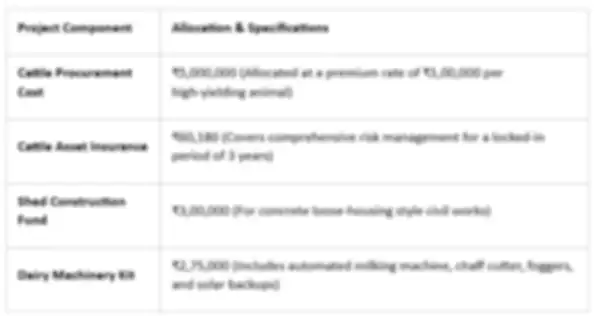
The scheme supports farmers who wish to establish commercial micro-dairy units by providing financial assistance not only for purchasing cattle but also for developing the necessary infrastructure.
What the Scheme Covers
The project package typically includes:
- Purchase of milch animals
- Dairy shed construction
- Milking equipment
- Insurance
- Basic infrastructure
- Initial working support
Standard Project Structure
The scheme is designed around a:
5 Milch Animal Dairy Unit
Estimated Project Cost
Approximately ₹11.35 Lakhs
The final project cost may vary depending on:
- Breed selected
- Infrastructure
- Equipment
- Market prices
- District-specific norms
This integrated approach helps first-generation dairy entrepreneurs establish a professionally managed dairy unit with substantially reduced financial risk.
Subsidy Structure
General Category Farmers
Eligible beneficiaries receive:
- 50% Direct Capital Subsidy
- State Contribution: Approximately ₹5.67 Lakhs
- Farmer Contribution: Remaining amount through own investment (equity) or a bank loan
SC / ST Category Farmers
To encourage inclusive rural entrepreneurship, the scheme offers enhanced financial assistance.
Eligible beneficiaries receive:
- 75% Direct Capital Subsidy
- State Contribution: Up to ₹8.51 Lakhs
This substantially reduces the initial capital required to establish a dairy enterprise.
Special Reservation Categories
The scheme also promotes inclusive participation through reserved allocations.
Women Entrepreneurs
- 30% of the total scheme allocation is reserved for:
- Women entrepreneurs
- Women Self-Help Groups (SHGs)
Persons with Disabilities
- 5% of the scheme allocation is reserved for specially-abled individuals.
2. State-Level Innovative Scheme for Milch Animal Distribution
(राज्यस्तरीय नावीन्यपूर्ण योजना)
If you already own a functional cattle shed or wish to start on a smaller scale before expanding into a commercial dairy operation, this scheme provides an excellent entry point.
Rather than funding a large dairy project immediately, it helps entrepreneurs gradually build their herd while understanding local milk demand and operational economics.
Scheme Highlights
Target Unit
Financial assistance is provided for the purchase of:
- Two premium indigenous (Desi) milch cows
Priority is generally given to recognized indigenous breeds such as:
- Gir
- Sahiwal
- Deoni
These breeds are well adapted to Maharashtra's climatic conditions and are valued for their productivity and resilience.
Standard Unit Cost
The benchmark project cost prescribed under the scheme is:
₹1,56,850
This cost covers the standard package for two indigenous milch cows, with periodic revisions based on prevailing livestock market prices.
Subsidy Pattern
General Category
Eligible beneficiaries receive:
- 50% Capital Subsidy
Approximate Subsidy Amount:
₹78,425
SC / ST Categories
Eligible beneficiaries receive:
- 75% Capital Subsidy
Approximate Subsidy Amount:
₹1,17,637
This higher subsidy significantly lowers the financial burden of purchasing quality indigenous cattle.
Strategic Funding Pipeline
How Maharashtra Releases Subsidies
One of the most common misconceptions among first-time dairy entrepreneurs is that subsidy funds are provided before project implementation.
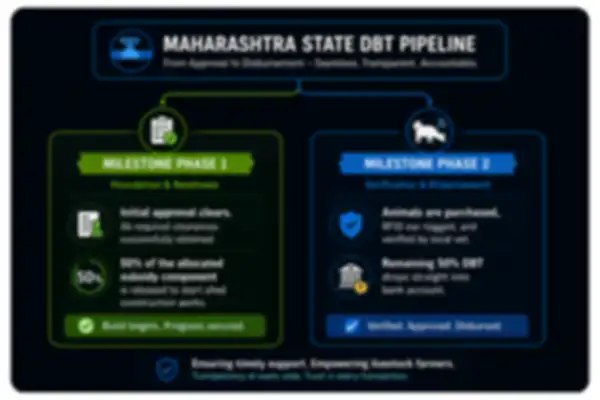
In reality, Maharashtra follows a Direct Benefit Transfer (DBT) model, where financial assistance is released only after specific project milestones are successfully completed and verified.
The process generally follows these stages:
Step 1 – Online Application
Applicants submit their application along with the required documents through the designated government portal or the local Department of Animal Husbandry office.
Step 2 – Project Approval
Officials verify:
- Applicant eligibility
- Project proposal
- Required documentation
- Availability of funds under the scheme
Upon approval, the project receives administrative sanction.
Step 3 – Loan Sanction (Where Applicable)
For credit-linked projects, the applicant secures a loan from an eligible financial institution based on the approved project report.
Step 4 – Purchase & Infrastructure Development
The beneficiary:
- Purchases the approved indigenous cattle.
- Constructs the dairy shed (if applicable).
- Installs approved equipment and infrastructure.
Step 5 – Physical Verification
Officials from the Animal Husbandry Department conduct an on-site inspection to verify that:
- The cattle have been purchased.
- Infrastructure has been completed.
- Scheme guidelines have been followed.
Step 6 – Direct Benefit Transfer (DBT)
After successful verification:
- The approved subsidy amount is released.
- Funds are transferred directly into the beneficiary's bank account through the Direct Benefit Transfer (DBT) system, ensuring transparency and minimizing delays.
The Subsidy Slabs:
- General Category Farmers: 50% Direct Subsidy (The state pays ₹5.67 Lakhs; you fund the rest via equity/bank loan).
- SC / ST Categories: 75% Direct Subsidy (The state pays up to ₹8.51 Lakhs, lowering your capital entry barrier drastically).
- Special Reservations: 30% of the entire scheme's budget layout is strictly reserved for women self-help groups (SHGs) and female entrepreneurs, alongside a 5% allocation for specially-abled individuals.
2. State Level Innovative Scheme (State Scheme for Milch Animal Distribution)
(राज्यस्तरीय नावीन्यपूर्ण योजना)
If you already possess a functional barn or want to start small by slowly testing your local market dynamics before scaling up to a 10-cow commercial unit, this specific rolling scheme is highly effective.
Scheme Highlights:
- The Target Unit: Provides credit-linked capital assistance for the purchase of 2 premium Indigenous (Desi) milch cows (specifically targeting pure Gir, Sahiwal, or Deoni breeds natively adapted to Maharashtra's climate).
- Capped Unit Cost: The standard benchmark cost fixed by the state animal husbandry board is ₹1,56,850 for a 2-indigenous cow package (accounting for localized livestock price variations).
- Subsidy Scale:
- General Category: 50% Subsidy (Get a direct back-ended reimbursement of ~₹78,425).
- SC / ST Categories: 75% Subsidy (Get a reimbursement of ~₹1,17,637).
The Strategic Funding Pipeline (How Subsidies Are Released)
A critical mistake urban corporate-turned-dairy farmers make is expecting the government to hand over raw cash before any work begins. Maharashtra strictly follows a Direct Benefit Transfer (DBT) model based on actual milestones:
How to Apply for Maharashtra Dairy Subsidy Schemes
Applying for Maharashtra's dairy subsidy schemes is now largely digital, making the process more transparent and streamlined.
Step 1: Online Portal Registration
Visit the official Maharashtra Animal Husbandry Department portal during the notified application period.
Official Portal:
Complete the online registration and submit your application.
Step 2: Create Your Applicant Profile
Upload all required documents, including:
- Aadhaar Card
- PAN Card (if applicable)
- Passport-size Photograph
- 7/12 Extract (Satbara Utara) or valid land lease documents
- Bank Account Details
- Mobile Number
- Other KYC documents as specified
Ensure that all uploaded documents are clear and up to date.
Step 3: Local-Level Verification
After submission, your application is automatically forwarded to the Taluka Livestock Development Officer (LDO) for verification.
The officer verifies:
- Land ownership/lease
- Eligibility
- Project feasibility
- Submitted documents
Step 4: Selection Process
Eligible applications are shortlisted through a district-level merit list or computerized lottery system, depending on the scheme.
Successful applicants receive:
- Official sanction order
- SMS notification on the registered mobile number
- Further instructions regarding implementation
Pro Tip: Which Scheme Should You Choose?
If your objective is to establish a commercial Desi cow dairy farm, the Mukhyamantri Gramin Pashudhan Udyogakta Yojana is generally the more comprehensive option.
Why?
Unlike the 2-cow innovative scheme, the 5-cow model provides support for:
- Purchase of milch animals
- Dairy shed construction
- Modern equipment
- Insurance
- Basic infrastructure
This allows you to preserve more of your own capital for:
- Quality cattle feed
- Veterinary care
- Working capital
- Branding and direct-to-consumer marketing
The Master Compendium: 2026 Indigenous Cow Dairy Schemes & Subsidies in Uttar Pradesh
Uttar Pradesh has emerged as one of India's most aggressively supported states for indigenous dairy farming.
Through Operation-4 and several dedicated dairy development programs, the state is promoting native breeds such as:
- Gir
- Sahiwal
- Tharparkar
- Gangatiri
These schemes aim to increase indigenous cattle populations, improve milk productivity, and encourage value-added dairy entrepreneurship.
I. Nand Baba Milk Mission (State-Funded)
The Nand Baba Milk Mission is Uttar Pradesh's flagship indigenous dairy initiative with an allocation of approximately ₹1,000 Crore.
It consists of multiple subsidy and incentive-based schemes.
1. Nandini Krishak Samriddhi Yojana
The 25-Cow Commercial Dairy Model
This scheme is designed for entrepreneurs intending to establish large-scale indigenous dairy farms.
Project Blueprint
- 25 indigenous milch cows
- Eligible breeds:
- Gir
- Sahiwal
- Tharparkar
- Gangatiri
Financial Structure
Estimated Project Cost
Up to ₹62.50 Lakhs
Capital Subsidy
Eligible entrepreneurs receive:
- 50% Capital Subsidy
- Maximum assistance of ₹31.25 Lakhs
Subsidy Release Schedule
Phase 1 – 25%
Released after:
- Construction of dairy shed
- Completion of basic infrastructure
Phase 2 – 12.5%
Released after:
- Purchase of cattle
- Ear tagging
- Transportation
- Verification
Phase 3 – 12.5%
Released after:
- Birth of at least 10 calves
- Verification by the concerned authorities
Land Requirement
Applicants must possess:
- 0.5 acre for dairy infrastructure
- 1.5 acres for green fodder cultivation
The land may be:
- Self-owned
- Ancestral property
- Registered lease (minimum 7 years)
2. Mini Nandini Krishak Samriddhi Yojana
Designed for small and medium dairy entrepreneurs.
Project Size
- 10–15 indigenous cows
Eligible breeds remain:
- Gir
- Sahiwal
- Tharparkar
- Gangatiri
Subsidy
- 50% Back-ended Capital Subsidy
The subsidy amount varies according to the approved project cost.
3. Mukhyamantri Swadeshi Gau Samvardhan Yojana
Entry-Level 2-Cow Dairy Scheme
Ideal for:
- First-time dairy entrepreneurs
- Small farmers
- Micro dairy businesses
Project Blueprint
Purchase of:
- Two indigenous milch cows
Eligible breeds include:
- Gir
- Sahiwal
- Tharparkar
- Haryana
Financial Structure
Approved Unit Cost
₹2 Lakhs
Subsidy
- 40% Capital Subsidy
- Maximum assistance of ₹80,000
The subsidy supports:
- Purchase of cattle
- Transportation
- Livestock insurance
- Basic shed improvements
Reservation
The scheme reserves:
- 50% of available benefits for:
- Women entrepreneurs
- Women-led Self-Help Groups (SHGs)
4. Mukhyamantri Pragatisheel Pashupalan Protsahan Yojana
Unlike capital subsidy schemes, this program provides performance-based cash incentives for high-yield indigenous cows.
Incentives
Daily Milk Yield: 8–12 Litres
Cash Incentive:
₹10,000 per eligible Desi cow
Daily Milk Yield: Above 12 Litres
Cash Incentive:
₹15,000 per eligible Desi cow
Payments are transferred directly to eligible farmers after verification.
II. Commercial & Risk Management Schemes
5. Gopalak Yojana
This scheme supports dairy entrepreneurs who require affordable financing for establishing a medium-sized dairy farm.
Project Structure
- 10 milch animals
- Indigenous cows or premium native buffaloes
Financial Assistance
- Bank loan up to ₹9 Lakhs
Interest Support
The State Animal Husbandry Department bears the interest cost, effectively making the loan interest-free for eligible beneficiaries.
6. UP Kamadhenu Pashu Bima Yojana
A livestock insurance program designed to protect dairy farmers against financial losses due to:
- Disease
- Accidents
- Natural calamities
Insurance Coverage
Coverage of:
₹40,000 per indigenous cow
Premium Subsidy
For Below Poverty Line (BPL) beneficiaries:
- 50% premium subsidy provided by the State Government
III. Central Government Schemes Available in Uttar Pradesh
In addition to state programs, dairy entrepreneurs in Uttar Pradesh can simultaneously benefit from Central Government schemes.
7. Rashtriya Gokul Mission (RGM)
Ideal for entrepreneurs planning large-scale indigenous breeding operations.
Benefit
For establishing a Breed Multiplication Farm with elite indigenous cattle:
- 50% Capital Subsidy
- Maximum assistance of ₹2 Crore
8. Animal Husbandry Infrastructure Development Fund (AHIDF)
Best suited for entrepreneurs planning to diversify into value-added dairy products such as:
- A2 Bilona Ghee
- Paneer
- Curd
- Cheese
- Packaged Milk
Benefits
- 3% annual interest subvention
- Available for up to 8 years
- 25% Credit Guarantee Cover for eligible infrastructure loans
2026 Application Checklist
Before applying through the Navratna Dairy Portal or the e-Pashuhaat platform, keep the following documents ready in digital format.
Land Documents
✔ Khatauni records
OR
✔ Registered lease deed (minimum 7 years)
Dairy Experience
✔ Dairy training certificate
OR
✔ Experience certificate issued by the Chief Veterinary Officer (CVO)
Cattle Procurement Plan
✔ Declaration describing:
- Source of indigenous cattle
- Breed details
- Transportation plan
This may help in claiming eligible transportation incentives.
Detailed Project Report (DPR)
Prepare a professionally prepared bankable DPR covering:
- Capital Expenditure (CapEx)
- Operating Expenses (OpEx)
- Milk production projections
- Feed costs
- Revenue projections
- Cash flow statement
- Debt Service Coverage Ratio (DSCR)
Financial Strategy
For entrepreneurs planning a commercial indigenous dairy enterprise, combining multiple schemes can significantly improve project viability.
A practical approach is to:
- Utilize the Nandini Krishak Samriddhi Yojana to receive substantial support for dairy infrastructure and herd establishment.
- Expand into value-added dairy products such as A2 Bilona Ghee, which typically offer higher margins than selling raw milk.
- Target premium urban markets such as Noida, Lucknow, and Varanasi, where demand for indigenous dairy products continues to grow.
- This integrated strategy can help improve profitability while making effective use of both State and Central Government support programs.

THAKUR G
Thakur G offers quality essentials for your kitchen and spiritual needs, from pure ghee and natural sweeteners to pooja thalis.
Follow us on


Contact Us
Call: +91 - 8689805934
WhatsApp: +91 - 8689805934
Customer Support Time: 24/7
Email: Shivam.mishra56@yahoo.com
Address: Office No. A 825, 8th Floor, Lodha Premier Signet A, DOMBIVLI east. mangaon ., Maharashtra, Thane, 421204