The Silent Extinction in Our Barns
Why Saving India's Native Bovine Genetics is a High-Stakes Economic Battle
We need to talk about a quiet yet devastating crisis unfolding across the rural landscapes of India—one that directly affects our food security, climate resilience, biodiversity, and agricultural economy.
This crisis is the genetic erosion of India's indigenous (Desi) cattle breeds.
For decades, the dairy sector has increasingly prioritized short-term milk production over long-term genetic sustainability. In the pursuit of higher milk yields, large numbers of Holstein Friesian (HF) and Jersey crossbreeds were introduced across the country.
At first glance, the strategy appeared economically sound. On paper, these crossbred animals promised significantly higher milk production.
However, practical experience revealed a different reality.
Many exotic and crossbred cattle:
- Are highly susceptible to tropical diseases.
- Require intensive nutritional management.
- Perform poorly under extreme summer temperatures.
- Have higher maintenance and veterinary costs.
- Experience productivity losses during heat stress.
In contrast, India's indigenous cattle have evolved over thousands of years under diverse climatic conditions. Their genetic traits make them naturally suited to local environments, offering qualities that are becoming increasingly valuable in the face of climate change.
These strengths include:
- Exceptional heat tolerance
- Better resistance to endemic diseases
- Lower maintenance costs
- Efficient utilization of locally available fodder
- Greater adaptability to harsh environmental conditions
- Longer productive lifespan
Unfortunately, many of these native genetic resources are now under threat due to indiscriminate crossbreeding and declining population sizes.
The conservation and improvement of indigenous cattle are therefore not only matters of cultural heritage but also strategic priorities for ensuring the future sustainability of Indian agriculture.
The Genetic Landscape: India's Diverse Bovine Heritage
When people think of a Desi cow, they often imagine a single generic breed.
In reality, India possesses one of the richest bovine genetic resources in the world, with more than 50 officially registered indigenous cattle breeds, each uniquely adapted to its local ecosystem.
These breeds were not developed by chance. Over centuries of natural selection and traditional breeding practices, they evolved to thrive in specific climatic zones, grazing conditions, and agricultural systems across the country.
From the arid deserts of Rajasthan to the humid coastal regions of Kerala, every breed exhibits distinctive characteristics that reflect its regional adaptation.
To better understand their roles, India's indigenous cattle are generally classified into three functional categories based on their primary utility.
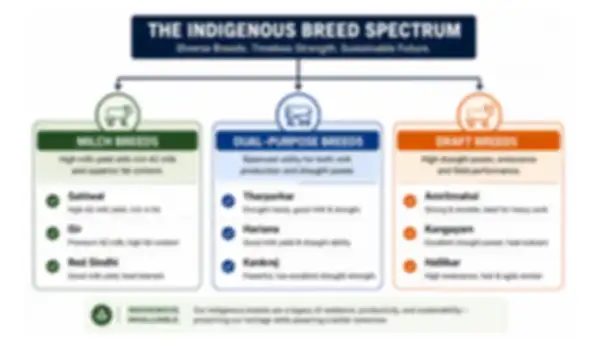
Functional Classification of Indigenous Cattle Breeds
India's native cattle breeds are generally classified into three functional categories based on their primary purpose and characteristics.
1. Milch Breeds (The Dairy Specialists)
These breeds are primarily valued for their high milk production and are among the most productive indigenous cattle in India.
Notable Milch Breeds
- Sahiwal (Punjab & Rajasthan)
- Gir (Gujarat)
- Red Sindhi (Sindh region; widely reared across India)
Key Characteristics
- High milk yield among indigenous breeds
- Rich A2 beta-casein milk
- Good fertility
- Better adaptability to tropical climates
- Lower maintenance compared to many exotic breeds
- Strong disease resistance
Because of these qualities, these breeds form the backbone of India's premium A2 dairy industry.
2. Dual-Purpose Breeds (The Backbone of Traditional Agriculture)
Dual-purpose breeds are valued for both:
- Milk production
- Draught power
Major Dual-Purpose Breeds
- Tharparkar
- Hariana
- Kankrej
Key Characteristics
- Moderate to good milk production
- Strong and durable bullocks
- Excellent endurance under drought conditions
- Suitable for ploughing, transportation, and farm operations
- Adapt well to semi-arid environments
These breeds have historically supported India's mixed farming systems by combining dairy production with agricultural labor.
3. Draft Breeds (The Powerhouses)
Draft breeds are primarily developed for strength, endurance, and work capacity, rather than milk production.
Major Draft Breeds
- Amritmahal
- Kangayam
- Hallikar
Key Characteristics
- Exceptional muscular strength
- Hard hooves suitable for rough terrain
- Excellent endurance
- Ability to survive on sparse vegetation
- Well adapted to arid and rugged landscapes
Although milk production is relatively low, these breeds remain invaluable in regions where mechanization is limited.
The Hidden Mechanisms of Indigenous Climate Resilience
The resilience of indigenous cattle is the result of thousands of years of natural adaptation to India's diverse climatic conditions.
Several biological characteristics make them particularly well suited for tropical environments.
1. Advanced Thermoregulation (Natural Heat Tolerance)
Heat stress is one of the greatest challenges in dairy farming.
Many exotic dairy breeds experience reduced productivity when exposed to prolonged high temperatures.
Indigenous breeds such as Gir and Tharparkar, however, are naturally adapted to withstand extreme summer conditions.
Biological Adaptations
Higher Sweat Gland Density
Desi cattle possess a greater density of sweat glands, allowing them to dissipate body heat more efficiently.
Hump
The characteristic hump serves as an energy reserve and contributes to metabolic efficiency during periods of nutritional stress.
Large Dewlap
The loose fold of skin beneath the neck (dewlap):
- Increases body surface area
- Improves heat dissipation
- Assists natural cooling under hot climatic conditions
These adaptations enable indigenous cattle to remain productive even in regions experiencing prolonged heat.
2. Disease Resistance and Tick Tolerance
Indigenous cattle have evolved under local disease pressures for centuries.
As a result, they generally exhibit:
- Better resistance to many tropical diseases
- Lower incidence of certain parasitic infestations
- Reduced dependence on veterinary interventions
Their skin characteristics and natural protective secretions also contribute to greater tolerance against ticks and external parasites.
This resilience can help reduce veterinary costs and improve overall herd health.
3. Efficient Utilization of Low-Quality Fodder
One of the greatest strengths of indigenous cattle is their ability to convert locally available feed resources into productive outputs.
Unlike many high-producing exotic breeds that require concentrated, protein-rich rations, Desi cattle can efficiently utilize:
- Crop residues (Bhusa)
- Dry fodder
- Native grasses
- Agricultural by-products
- Fibrous roughages
Their highly efficient rumen microbial ecosystem enables them to produce:
- Nutritious milk
- Organic manure
- Biogas feedstock
This makes them particularly suitable for low-input and sustainable farming systems.
Small Advantages with Big Economic Impact
The conservation of indigenous cattle extends beyond preserving biodiversity—it also strengthens the economic sustainability of rural farming systems.
Organic Fertility Engine
An indigenous cow typically produces:
- 10–15 kg of dung per day
- Several litres of urine daily
These are valuable agricultural inputs rather than waste products.
Major Uses
Dung and urine are widely used in preparing traditional organic formulations such as:
- Jeevamrut
- Ghanajeevamrut
- Panchagavya
These formulations help:
- Improve soil microbial activity
- Enhance soil fertility
- Reduce dependence on chemical fertilizers
- Support regenerative agriculture
Healthy indigenous cattle therefore contribute directly to sustainable crop production.
Preventing Inbreeding Depression
As populations of pure indigenous breeds decline, maintaining genetic diversity becomes increasingly important.
Repeated breeding within a limited pool of closely related animals can result in inbreeding depression, leading to:
- Reduced milk production
- Lower fertility
- Structural abnormalities
- Higher calf mortality
- Increased susceptibility to disease
Modern breeding strategies help preserve genetic quality through:
- Scientific pedigree recording
- Open nucleus breeding systems
- Artificial insemination (AI)
- Genetic evaluation
- Breed conservation programs
Maintaining broad genetic diversity is essential for the long-term health and productivity of indigenous cattle populations.
The 2026 Conservation Roadmap
Making Breed Conservation Economically Sustainable
Long-term conservation succeeds only when it also provides sustainable income for farmers.
Modern conservation strategies therefore combine scientific breeding, value addition, and resource optimization.
1. Precision Artificial Insemination & IVF
Genetic Improvement
Advanced reproductive technologies enable faster multiplication of elite indigenous genetics.
These include:
- Artificial Insemination (AI)
- Sex-Sorted Semen
- Embryo Transfer Technology (ETT)
- In-Vitro Fertilization (IVF)
Potential benefits include:
- Faster genetic improvement
- Increased production of female calves
- Improved milk productivity
- Better herd quality
- Conservation of superior bloodlines
2. Moving Beyond Raw Milk
Value Addition
Rather than relying solely on the sale of raw milk, farmers can improve profitability by processing milk into premium products.
Examples include:
- A2 Bilona Ghee
- Paneer
- Butter
- Curd
- Cheese
- Traditional dairy products
Value addition helps:
- Increase profit margins
- Extend product shelf life
- Reduce dependence on fluctuating milk procurement prices
- Access premium urban and niche markets
3. Utilizing Secondary Bio-Products
Building a Circular Farm Economy
A well-managed indigenous dairy farm can generate income from multiple outputs.
Cow Dung
Can be processed into:
- Vermicompost
- Organic manure
- Biogas
- Bio-slurry
Cow Urine
Can be utilized for:
- Organic pest repellents
- Bio-enhancers
- Agricultural formulations
- Natural farming inputs
Diversifying income sources improves farm resilience and reduces dependence on milk sales alone.
Final Outlook
Conserving India's indigenous cattle is far more than preserving a cultural legacy—it is a strategic investment in the future of Indian agriculture.
Native breeds possess unique genetic traits that contribute to:
- Climate resilience
- Disease resistance
- Sustainable dairy production
- Soil health
- Biodiversity conservation
- Rural livelihoods
By combining scientific breeding, modern dairy management, value-added processing, and efficient utilization of farm by-products, indigenous cattle conservation can become both environmentally sustainable and economically rewarding.
Protecting these genetic resources today will help build a more resilient, self-sufficient, and sustainable agricultural system for future generations.

THAKUR G
Thakur G offers quality essentials for your kitchen and spiritual needs, from pure ghee and natural sweeteners to pooja thalis.
Follow us on


Contact Us
Call: +91 - 8689805934
WhatsApp: +91 - 8689805934
Customer Support Time: 24/7
Email: Shivam.mishra56@yahoo.com
Address: Office No. A 825, 8th Floor, Lodha Premier Signet A, DOMBIVLI east. mangaon ., Maharashtra, Thane, 421204